
Magical Success Realty: DIY vs REALTOR Disclosure Guide

September 22, 20267 min read

When you search for DIY seller disclosure advice, you find different answers everywhere. One site calls the form simple; another warns about lawsuits tied to a failure to disclose when selling a house.

This comparison sorts out the real difference between handling your own paperwork and working with a licensed Chandler REALTOR.

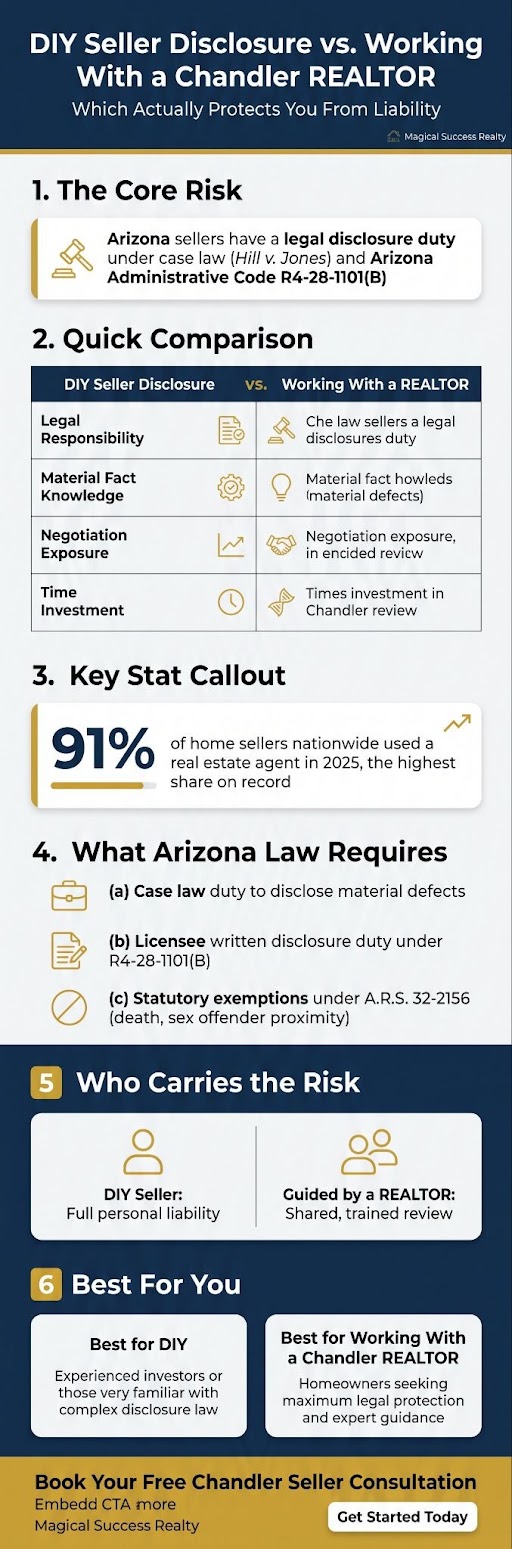
The paperwork itself is not complicated, but the legal risk behind it is. Handling it alone means you remain responsible for your disclosures, while a REALTOR can provide professional guidance throughout the process.
img

Quick Comparison: DIY Seller Disclosure vs. a Chandler REALTOR

A failure to disclose when selling a house usually traces back to one missed detail, shown below under each approach.

Factor

DIY Seller Disclosure

Working With a Chandler REALTOR

Legal responsibility for accuracy

You remain responsible for your disclosures

REALTOR provides professional guidance, but you remain responsible for seller disclosures

Knowledge of what counts as a "material fact"

Self-researched

Trained under Arizona real estate licensing standards

Negotiation exposure after disclosure

You handle it alone.

Managed as part of contract and offer strategy

Time investment

Several hours of independent research

Guided walkthrough, start to finish

Cost

No commission, but full personal liability

The seller pays the fee but shares the risk.

What Arizona Law Actually Requires

Arizona has no single statute listing every fact a seller must disclose. The duty comes from case law: Hill v. Jones holds that a seller who knows of a material defect not readily observable to the buyer must disclose it, and nondisclosure can carry the same legal weight as fraud.

Separately, Arizona Administrative Code R4-28-1101(B) requires a licensee to disclose in writing any information that materially affects the transaction.

Arizona law also carves out exceptions. Under A.R.S. Section 32-2156, a seller need not disclose that a property was the site of a death or is near a registered sex offender.

What Working With Magical Success Realty REALTOR Does Best

A REALTOR at Magical Success Realty treats a failure to disclose when selling a house as a preventable risk, not an afterthought you deal with once a buyer's attorney gets involved. That distinction can help reduce the risk of missed disclosures if a buyer later raises concerns.

How a Data-Driven Pricing and Disclosure Process Works

A qualified REALTOR treats pricing and disclosure as one connected task, not two separate steps.

Every comparable sale, repair history, and known defect feeds into a single pricing and disclosure conversation before the listing goes live, using the same absorption-rate and comparable-sales approach Magical Success Realty applies across its Seller Listing Service.

Arizona salespersons and brokers must also complete education and pass a state exam under A.R.S. Section 32-2124 before representing a seller.

A potential failure to disclose may come to light during the inspection or appraisal process. Reviewing absorption rates and negotiation risk alongside the disclosure statement means a known defect gets priced into the offer strategy instead of becoming a surprise credit request later.

Why Guided Sellers Avoid the Most Common Disclosure Mistakes

Most disclosure problems start when a seller assumes a minor issue does not count as "material" or assumes a statutory exemption covers more than it does.

A trained REALTOR asks the follow-up questions a first-time seller rarely thinks to ask, such as whether a repair was ever attempted or only partially completed.

One documented Arizona case shows how this plays out.

According to the Arizona Association of REALTORS, a seller and listing broker were sued for negligent misrepresentation after a nearby sex offender issue surfaced, even though A.R.S. Section 32-2156 exempts that specific fact from mandatory disclosure.

The lawsuit centered on other statements about the property, showing why the exact boundary of an exemption matters more than assuming it covers everything.

What Chandler First-Time Sellers Get That a DIY Filing Does Not Provide

If English is not your first language, or you are selling a home in the United States for the first time, the legal terminology on a disclosure form adds a second layer of risk.

Fair housing protections apply regardless of your primary language, and a bilingual, Chandler-based REALTOR walks you through each disclosure line in plain language.

What to Verify Before You Sign With Any Agent

Before you commit to representation, confirm your agent holds an active license through the Arizona Department of Real Estate public license database, and ask how many disclosure-related transactions they have personally handled.

Request a written listing agreement that states the fee structure and cancellation terms before you sign anything.

What DIY Sellers Handle Alone

A seller who manages a home sale without representation remains responsible for identifying and disclosing known material facts.

That seller identifies every material fact, correctly completes the Seller Property Disclosure Statement, and interprets Arizona case law and licensing rules without a second opinion.

Every Task Sits on One Person's Shoulders

A DIY seller negotiates directly with the buyer over any repair credits tied to what gets disclosed, coordinates the inspection and appraisal timeline personally, and manages every escrow deadline without a trained reviewer checking the paperwork first.

The Hill v. Jones disclosure duty and the R4-28-1101(B) written-disclosure rule still apply the same way either way.

The Key Differences That Matter

The paperwork looks identical either way, but a failure to disclose when selling a house exposes each path to different consequences.

Who Absorbs the Cost of an Inspection or Appraisal Gap

Yes, a DIY seller keeps the full sale price without paying a commission, but that saving disappears fast when an inspection uncovers an issue that should have been disclosed earlier.

Who Legally Carries the Risk When the SPDS Is Wrong, Incomplete, or Self-Managed

This is the question most disclosure guides skip. Arizona case law recognizes that nondisclosure of certain known material facts can carry serious legal consequences.

A REALTOR can review the disclosure process and help identify potential issues, but the seller remains responsible for providing accurate information.

Which Option Is Best for You?

The right choice depends on how much personal liability you want to carry alone.

Best for DIY Sellers

Sellers comfortable independently researching Arizona disclosure law fit the DIY path.

Best for Working With a Chandler REALTOR

Chandler first-time and immigrant sellers who want a licensed professional managing accuracy, pricing, and negotiation fit the guided path instead.

Frequently Asked Questions

Q1. What must I disclose when selling a house in Arizona?

Case law from Hill v. Jones requires you to disclose known material facts affecting a property's value, and Arizona Administrative Code R4-28-1101(B) places a similar written disclosure duty on your licensee.

Q2. Can I fill out the Seller Property Disclosure Statement myself?

Yes, Arizona does not require an agent to complete the form. The real risk sits in identifying every material fact correctly, not simply in filling out the paperwork itself.

Q3. What happens if a seller in Chandler forgets to disclose a known defect?

A documented Arizona case shows an undisclosed known issue can lead to a lawsuit against the seller, according to the Arizona Association of REALTORS. Courts can treat nondisclosure the same way they treat fraud.

Q4. Does a REALTOR fill out the disclosure form for me?

A REALTOR reviews each line of the form with you and flags anything that may qualify as a material fact, but you still sign the completed form as the seller of record.

Q5. How much does it cost to work with a Chandler REALTOR when selling?

Fee structures vary by listing agreement, and Magical Success Realty discusses pricing directly during a free consultation before you sign anything or commit to a listing.

Making the Right Call for Your Sale

A failure to disclose when selling a house rarely comes from dishonesty. It usually comes from not knowing what legally counts as material.

Book your next step today with Magical Success Realty.

Both paths lead to the same signed disclosure form. The difference is whether you check it alone or alongside a trained REALTOR before it reaches a buyer. Book your free Chandler seller consultation with Magical Success Realty today.

Custom HTML/CSS/JavaScript


Back to Blog

Magical Success Realty: DIY vs REALTOR Disclosure Guide

September 22, 20267 min read

When you search for DIY seller disclosure advice, you find different answers everywhere. One site calls the form simple; another warns about lawsuits tied to a failure to disclose when selling a house.

This comparison sorts out the real difference between handling your own paperwork and working with a licensed Chandler REALTOR.

The paperwork itself is not complicated, but the legal risk behind it is. Handling it alone means you remain responsible for your disclosures, while a REALTOR can provide professional guidance throughout the process.

img

Quick Comparison: DIY Seller Disclosure vs. a Chandler REALTOR

A failure to disclose when selling a house usually traces back to one missed detail, shown below under each approach.

Factor

DIY Seller Disclosure

Working With a Chandler REALTOR

Legal responsibility for accuracy

You remain responsible for your disclosures

REALTOR provides professional guidance, but you remain responsible for seller disclosures

Knowledge of what counts as a "material fact"

Self-researched

Trained under Arizona real estate licensing standards

Negotiation exposure after disclosure

You handle it alone.

Managed as part of contract and offer strategy

Time investment

Several hours of independent research

Guided walkthrough, start to finish

Cost

No commission, but full personal liability

The seller pays the fee but shares the risk.

What Arizona Law Actually Requires

Arizona has no single statute listing every fact a seller must disclose. The duty comes from case law: Hill v. Jones holds that a seller who knows of a material defect not readily observable to the buyer must disclose it, and nondisclosure can carry the same legal weight as fraud.

Separately, Arizona Administrative Code R4-28-1101(B) requires a licensee to disclose in writing any information that materially affects the transaction.

Arizona law also carves out exceptions. Under A.R.S. Section 32-2156, a seller need not disclose that a property was the site of a death or is near a registered sex offender.

What Working With Magical Success Realty REALTOR Does Best

A REALTOR at Magical Success Realty treats a failure to disclose when selling a house as a preventable risk, not an afterthought you deal with once a buyer's attorney gets involved. That distinction can help reduce the risk of missed disclosures if a buyer later raises concerns.

How a Data-Driven Pricing and Disclosure Process Works

A qualified REALTOR treats pricing and disclosure as one connected task, not two separate steps.

Every comparable sale, repair history, and known defect feeds into a single pricing and disclosure conversation before the listing goes live, using the same absorption-rate and comparable-sales approach Magical Success Realty applies across its Seller Listing Service.

Arizona salespersons and brokers must also complete education and pass a state exam under A.R.S. Section 32-2124 before representing a seller.

A potential failure to disclose may come to light during the inspection or appraisal process. Reviewing absorption rates and negotiation risk alongside the disclosure statement means a known defect gets priced into the offer strategy instead of becoming a surprise credit request later.

Why Guided Sellers Avoid the Most Common Disclosure Mistakes

Most disclosure problems start when a seller assumes a minor issue does not count as "material" or assumes a statutory exemption covers more than it does.

A trained REALTOR asks the follow-up questions a first-time seller rarely thinks to ask, such as whether a repair was ever attempted or only partially completed.

One documented Arizona case shows how this plays out.

According to the Arizona Association of REALTORS, a seller and listing broker were sued for negligent misrepresentation after a nearby sex offender issue surfaced, even though A.R.S. Section 32-2156 exempts that specific fact from mandatory disclosure.

The lawsuit centered on other statements about the property, showing why the exact boundary of an exemption matters more than assuming it covers everything.

What Chandler First-Time Sellers Get That a DIY Filing Does Not Provide

If English is not your first language, or you are selling a home in the United States for the first time, the legal terminology on a disclosure form adds a second layer of risk.

Fair housing protections apply regardless of your primary language, and a bilingual, Chandler-based REALTOR walks you through each disclosure line in plain language.

What to Verify Before You Sign With Any Agent

Before you commit to representation, confirm your agent holds an active license through the Arizona Department of Real Estate public license database, and ask how many disclosure-related transactions they have personally handled.

Request a written listing agreement that states the fee structure and cancellation terms before you sign anything.

What DIY Sellers Handle Alone

A seller who manages a home sale without representation remains responsible for identifying and disclosing known material facts.

That seller identifies every material fact, correctly completes the Seller Property Disclosure Statement, and interprets Arizona case law and licensing rules without a second opinion.

Every Task Sits on One Person's Shoulders

A DIY seller negotiates directly with the buyer over any repair credits tied to what gets disclosed, coordinates the inspection and appraisal timeline personally, and manages every escrow deadline without a trained reviewer checking the paperwork first.

The Hill v. Jones disclosure duty and the R4-28-1101(B) written-disclosure rule still apply the same way either way.

The Key Differences That Matter

The paperwork looks identical either way, but a failure to disclose when selling a house exposes each path to different consequences.

Who Absorbs the Cost of an Inspection or Appraisal Gap

Yes, a DIY seller keeps the full sale price without paying a commission, but that saving disappears fast when an inspection uncovers an issue that should have been disclosed earlier.

Who Legally Carries the Risk When the SPDS Is Wrong, Incomplete, or Self-Managed

This is the question most disclosure guides skip. Arizona case law recognizes that nondisclosure of certain known material facts can carry serious legal consequences.

A REALTOR can review the disclosure process and help identify potential issues, but the seller remains responsible for providing accurate information.

Which Option Is Best for You?

The right choice depends on how much personal liability you want to carry alone.

Best for DIY Sellers

Sellers comfortable independently researching Arizona disclosure law fit the DIY path.

Best for Working With a Chandler REALTOR

Chandler first-time and immigrant sellers who want a licensed professional managing accuracy, pricing, and negotiation fit the guided path instead.

Frequently Asked Questions

Q1. What must I disclose when selling a house in Arizona?

Case law from Hill v. Jones requires you to disclose known material facts affecting a property's value, and Arizona Administrative Code R4-28-1101(B) places a similar written disclosure duty on your licensee.

Q2. Can I fill out the Seller Property Disclosure Statement myself?

Yes, Arizona does not require an agent to complete the form. The real risk sits in identifying every material fact correctly, not simply in filling out the paperwork itself.

Q3. What happens if a seller in Chandler forgets to disclose a known defect?

A documented Arizona case shows an undisclosed known issue can lead to a lawsuit against the seller, according to the Arizona Association of REALTORS. Courts can treat nondisclosure the same way they treat fraud.

Q4. Does a REALTOR fill out the disclosure form for me?

A REALTOR reviews each line of the form with you and flags anything that may qualify as a material fact, but you still sign the completed form as the seller of record.

Q5. How much does it cost to work with a Chandler REALTOR when selling?

Fee structures vary by listing agreement, and Magical Success Realty discusses pricing directly during a free consultation before you sign anything or commit to a listing.

Making the Right Call for Your Sale

A failure to disclose when selling a house rarely comes from dishonesty. It usually comes from not knowing what legally counts as material.

Book your next step today with Magical Success Realty.

Both paths lead to the same signed disclosure form. The difference is whether you check it alone or alongside a trained REALTOR before it reaches a buyer. Book your free Chandler seller consultation with Magical Success Realty today.

Custom HTML/CSS/JavaScript


Back to Blog

Follow Long Le On Social

Quick Info

1971 W Chilton Dr, Chandler, AZ 85224, United States

480-480-7948

© Copyright Arizona 2026. All rights reserved.