
Buyer's Course
Here's What You Need to Know About Buying a Home in Chandler, Arizona...

BUYER'S COURSE
Buyer's Blueprint Intro
Module 1: You Need An Expet
Module 2: Buyer's Compensation
Module 3: Choosing the Right Lender
Module 4: Making an Offer and Negotiations
Module 5: Your Offer Is Accepted
Module 6: Inspections Are Complete
Module 7: The Final Steps
Module 8: Erin Brockovich Buyer Compensation
Module 9: Should Sellers Offer Buyer Compensation
Module 10: The Buyer Representation Agreement
Module 11: The Listing Agreement
Module 12: The Purchase Agreement
Module 13: Which Offer Should You Choose
Whether you're a first-time buyer or looking to upgrade your living situation, our tailored market updates, captivating community videos, and comprehensive real estate insights make your home-buying journey seamless and enjoyable.
Exclusive Market Updates
Stay ahead of the curve with our up-to-minute market updates. From the latest listings to price trends, we ensure you have all the information you need to make informed decisions. East Bay's real estate landscape is dynamic, and with our expert analysis, you're always in the know.
Want to be sure you don't miss out on any local tips & local real estate market updates?
Have them delivered to your inbox.
Subscribe to the monthly digital newsletter below!
MARKET UPDATE

Considering Buying?
Buying a home can be an exciting but also challenging experience. If you're planning to buy an East Bay home, it's important to be prepared and aware of what to expect throughout the process. This short guide is designed to provide buyers like you with valuable insights and tips to navigate the purchase of your East Bay property successfully.
Preparing for a possible move this year? Click below to check out our moving checklist to get your whole house ready for the next home!
Join Our Virtual Seller Seminar For Chandler Arizona
At Magical Success Realty, we know that selling your house is a big step. You might feel overwhelmed or burdened by everything involved in selling your house.
You might be wondering what your house is worth or if it’s really the right time to sell. This is where we can help.
Over the last XX years we've sold over XXXX+ homes and now we're sharing exactly how so you can sell your home too. Inside of the seller seminar you'll get step by step videos breaking down everything you need to know BEFORE selling your home - to get the highest price possible, in the quickest time possible.
Take a sneak peek at what's inside the buyer seminar's videos!
After signing up for the Workshop, you will get instant access to Long's Home-Buying Educational Videos

Thinking About Buying?
"Are you thinking about buying a home but you don't know where to start?"

What to Expect When Buying a Home
"Purchasing a home is most likely going to be one of the largest investments you will make in your lifetime."

Home Buying Process- First Step
"The first step when looking to buy a home is getting qualified for a loan."

Pre-Approval vs
Pre-Qualification
"Why you need an approval rather than just a pre-qualification."

10 Must Not’s When Buying
a Home
"Once you find your dream home, we need to make sure you get to move into it."

What are the Pros and Cons of Purchasing a Home?
"Once you find your dream home, we need to make sure you get to move into it."

How Much Money Do I Need To Purchase a New Home?
"Are you thinking about buying a home but you don't know where to start?"

3 Tips To Get Your Offer Accepted
"Are you competing with other buyers on your dream home or do you want to make sure you’ve got the best chance of getting your offer accepted?"

Offer Has Been Accepted,
What’s Next?
"The first step when looking to buy a home is getting qualified for a loan."
Community Videos
Scottsdale Fashion Square Centre
1832 W Broadway Rd #100, Mesa
Biltmore Fashion Square
2502 E Camelback Rd, Phoenix, AZ 85016
Get 30 Smart Tips to Prepare for Your Home Buying Journey
Sign up to receive simple, practical advice that helps you plan ahead, avoid costly mistakes, and feel confident before buying your home.
About Long Le
Top Chandler Arizona REALTOR®
Long Le is the founder and team leader of Magical Success Realty, an award-winning real estate team based in Chandler, Arizona. As an immigrant who overcame hesitation and cultural uncertainty to achieve homeownership, Long is uniquely equipped to guide first-time immigrant buyers through the complex home buying process with clarity and confidence. With nearly a decade of experience and a background in engineering, he specializes in helping clients overcome analysis paralysis and avoid buyer’s remorse by focusing on practical execution—one step at a time.
Recognized as a Top 1% agent in the region, Long has saved his clients over $846,000 in the past year alone, earning more than 100 five-star Google reviews for his negotiation expertise and client-first approach. With his step-by-step strategies and signature “The Magical Home Buying Method” webinar, Long empowers buyers to make smart decisions, build family foundations, and achieve the lasting pride of homeownership. To learn more, visit www.magicalsuccessrealty.com.

Meet The Magical Success Realty Team
Magical Success Realty is a real estate team led by Long Le, serving home buyers and sellers in Chandler, Phoenix and surrounding Arizona markets. We focus on buyer representation, seller listing strategy, and data-driven real estate decisions. Long leverages his professional engineering background and advanced market analysis to craft winning negotiation strategies.
Our marketing strengths included:
Professional photography and high-quality video production to showcase each home at its best
Strategic social media campaigns designed to reach highly targeted, qualified buyers
Custom, information-rich landing pages built specifically for every listing
AI-powered tools used to personalize and optimize the marketing strategy for each client
A modern, data-driven approach that helps listings stand out in a competitive market

Long Le
Team Leader

Tam Huynh
Operation Manager

Huong Chau
Content Manager

Louis Nguyen
Marketing Manager
Visit our blogs for more real estate tips, home tips, and local information!
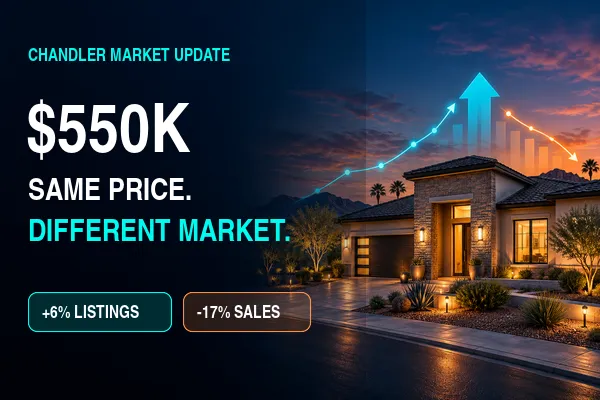
Prices Stayed at $550K, But Buyers Have More Choices | Chandler Market Update
Chandler’s median sale price stayed at $550,000—but underneath that stable price, the market changed.
Between the August 29 and September 29 market snapshots, active listings increased from 471 to 501, or approximately 6%. At the same time, monthly sales declined from 209 to 173, a drop of roughly 17%.
That means buyers now have more available homes to compare relative to the recent pace of sales, even though the median sale price hasn't declined. We're also seeing a slightly wider gap between final asking prices and actual sale prices. However, homes that successfully attract buyers aren't necessarily taking longer to reach a contract.
For first-time buyers, that's an important distinction. A flat median price doesn't mean negotiating conditions stayed flat. Let's look at what the most recent data on the Chandler housing market
actually tells us—and how it could affect your next offer.
Key Market Highlights
Chandler’s Median Sale Price Remains at $550,000
Chandler’s monthly median sale price was $550,000 in both the August 29 and September 29 snapshots. Prices were flat between the two snapshots, but several underlying market indicators changed.
Active Listings Increased About 6%
Active listings, excluding homes in the under-contract/backup category, increased from 471 to 501. That gives buyers more available choices than they had a month earlier.
Monthly Sales Fell About 17%
Monthly sales declined from 209 to 173. More available inventory combined with fewer recent sales suggests buyers may have more opportunity to compare alternatives and negotiate.
Homes Sold for an Average 97.72% of Final Asking Price
Chandler’s average sale-price-to-final-asking-price ratio decreased from 98.04% to 97.72%. That's a relatively small 0.32-percentage-point change, but it indicates a slightly wider gap between the final asking price and closing price.
Pending Listings Declined, but Contract Timing Didn't Increase
Pending listings declined from 104 to 89, yet the median time to first contract moved from 25 days to 24 days. These indicators measure different groups of listings, so they don't prove which homes are attracting buyers, but they do show why we shouldn't assume every Chandler home is taking longer to find a buyer.
Key #1 — Chandler Prices Stayed Flat, but Negotiating Conditions Changed
If you looked only at Chandler's median sale price, you might conclude that almost nothing changed over the past month.
The monthly median sale price was $550,000 in both the August 29 and September 29 snapshots. But look underneath that number. Active listings, excluding the under-contract/backup category, increased from 471 to 501 homes—approximately 6%.
Meanwhile, monthly sales declined from 209 to 173, or approximately 17%. That combination matters. Buyers now have more available homes to choose from relative to the recent pace of sales.
This doesn't automatically mean sellers will accept aggressive offers. It does mean buyers may have more opportunities to compare competing listings instead of feeling pressure to pursue the first suitable home they find. That's why median price alone doesn't tell us who has negotiating leverage.
A stable median price does not mean the balance between buyers and sellers stayed the same.
Key #2—The Gap Between Final Asking Price and Sale Price Widened Slightly
Another indicator suggests negotiating conditions improved slightly for buyers.
Chandler’s average sale price as a percentage of the final asking price declined from 98.04% to 97.72%.
That's a difference of only 0.32 percentage points, so it shouldn't be interpreted as a dramatic market shift. But it does indicate a slightly wider gap between final asking prices and actual closing prices.
There's also an important detail hidden inside this statistic. It compares the sale price with the final asking price—not necessarily the home's original asking price.
Imagine a seller originally lists a home at $550,000. After sitting on the market, they reduce it to $525,000 and eventually sell near that new asking price. The sale-to-final-list-price statistic captures the relationship with $525,000, not the full journey from the original $550,000 asking price. That's why seeing a price reduction doesn't automatically tell us how much additional negotiating room remains.
One seller may have already made a major adjustment. Another seller may have priced competitively from the beginning.
Before deciding what to offer, buyers should examine:
Original asking price
Complete price history
Days on market
Comparable sales
Competing listings
Property condition
Current buyer competition
The average 97.72% ratio is market context—not a formula for your offer.
Key #3 — The Market Is Slowing, but Successful Listings Aren't Taking Longer to Reach a Contract
Here's one of the more interesting contrasts in this week's Chandler data.
Pending listings declined from 104 to 89.
You might assume that means every home is taking longer to find a buyer.
But Chandler's median time to first contract actually moved from 25 days to 24 days.
These two metrics measure different groups of listings, so they shouldn't be combined to claim that certain types of homes are definitely selling faster.
But they do provide an important warning against oversimplifying the market.
A slower citywide market does not mean every Chandler home is moving slowly.
Some listings can still attract buyers relatively quickly.
That's why the question for a buyer shouldn't simply be:
“Is Chandler slowing down?”
A more useful question is:
“How does this particular home compare with all the other choices buyers have today?”
If a home is newly listed, in good condition, competitively priced, and attractive relative to the alternatives, there may still be competition.
If another property is overpriced, needs significant work, or has been sitting while competing listings sell, the negotiating strategy may be very different.
Key #4 — Market Averages Shouldn't Decide Your Offer
This week's numbers lead to one larger lesson for Chandler buyers: Market data should guide your investigation, not automatically determine your offer. The median sale price is flat. Inventory increased. Monthly sales declined. The average sale-to-final-asking-price ratio decreased slightly.
Pending listings declined, while median time to first contract didn't increase. None of those numbers alone tells you that you should offer $5,000, $10,000, or $20,000 below asking.
Your negotiating leverage depends on the individual property. Before writing an offer, compare the home against recent comparable sales, examine its listing and price history, evaluate its condition, and understand what alternatives are currently available. That tells you much more than simply applying a citywide average to one property.
Key #5 — A Lower Price Doesn't Automatically Mean Better Value
The market data also connects to another important issue for first-time buyers: purchase price is only one part of the cost of owning a home.
Before pursuing a discount, compare three things:
Price: How does the asking price compare with similar homes that recently sold?
Condition: What work does the property need now or potentially in the near future?
Cash after closing: How much money will you have left for repairs, maintenance, emergencies, and moving expenses?
A lower-priced home can require additional work that the buyer has to fund and manage after closing. At the same time, a renovated or move-in-ready home still needs a proper inspection. For example, saving $20,000 on the purchase price isn't automatically better if the home requires substantial repairs immediately after closing.
The goal isn't simply to find the biggest discount. The goal is to understand what you're actually buying and what the home may require after you own it.
Buyer Takeaways
For first-time buyers in Chandler, the latest numbers suggest that you may have more choices without seeing a major decline in the median sale price.
That can be valuable. More inventory relative to recent sales gives buyers additional opportunities to compare properties instead of focusing on one listing in isolation.
But don't turn citywide statistics into an automatic offer strategy. Before making an offer, review comparable sales, the complete listing history, property condition, and suitable alternatives currently on the market.
Then, during the inspection and investigation period, examine any concerns you discover and obtain qualified estimates within the deadlines established by your contract.
The question isn't simply: “How much below asking can I offer?”
It's: “Does the price, condition, competition, and total cost of this home make sense for my family?”
Seller Takeaways
For Chandler sellers, the $550,000 median sale price remaining unchanged is encouraging, but the underlying market shouldn't be ignored.
Buyers have more active listings to choose from, monthly sales have declined, and the average sale price relative to final asking price has edged lower.
That makes pricing and property condition increasingly important.
A seller who starts substantially above what competing properties justify may eventually have to reduce the asking price. Meanwhile, a well-positioned home can still reach a contract relatively quickly—the median time to first contract was 24 days in the latest snapshot. The market may be slower overall, but that doesn't mean every listing will experience the same result.

What others are saying
Want to be sure you don't miss out on any local tips & local real estate market updates?
Have them delivered to your inbox.
Subscribe to the monthly digital newsletter below!


